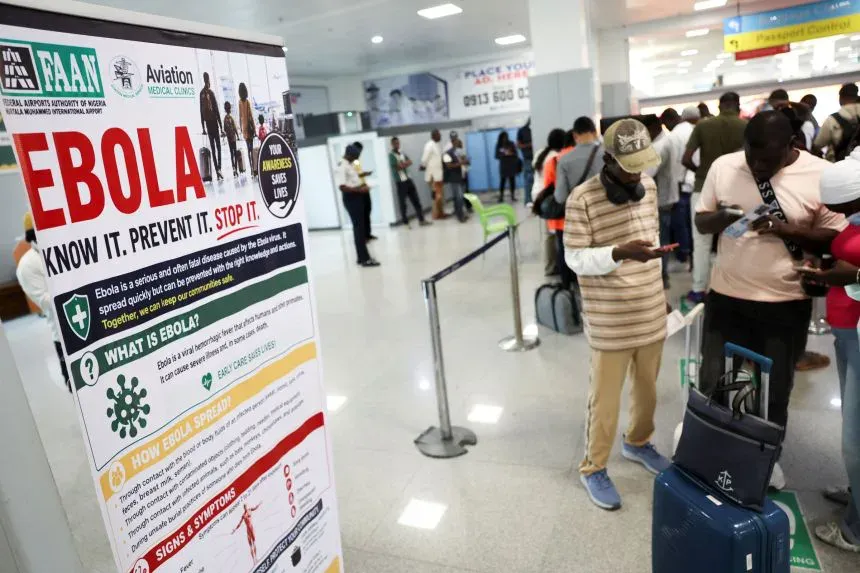
Nigeria’s First Ebola Patient Gets Evacuated to Switzerland
A Swiss woman receiving treatment for Ebola in Nigeria was evacuated to Switzerland alongside her husband on Monday, while health authorities in Nigeria continued monitoring 52 people who had been in contact with her.
Nigeria’s Health Minister, Muhammad Pate, said the woman departed Abuja early Monday after he authorized the medical evacuation. Her condition had improved considerably following treatment, and she was stable, conscious and able to communicate, according to the minister.
However, Pate warned that her improved condition did not necessarily mean she was no longer infectious. He said strict medical and safety precautions remained essential to prevent further transmission. The woman’s husband, a Swiss diplomat working in Nigeria, had not developed any symptoms.
Switzerland’s Federal Office of Public Health confirmed that the couple arrived in the country on a medical evacuation flight on Monday. The woman was admitted to Geneva University Hospital for continued treatment, while her husband was placed in isolation at Zurich University Hospital.
Swiss health officials said both facilities had the necessary resources to manage the situation and emphasized that the public faced no risk from the arrival of the couple.
Mohamed Janabi, the World Health Organization’s regional director for Africa, said the evacuation was organized because both individuals were Swiss citizens. He explained that Nigerian medical teams had successfully stabilized the woman after treating her through the most acute stage of the disease.
Despite the evacuation, Nigerian authorities will continue monitoring the 52 individuals identified as contacts, Janabi said. He added that Nigeria currently had no remaining Ebola patients following the departure of the woman and her husband, while emphasizing the need for continued vigilance.
Pate also urged the public to remain alert, noting that containment procedures were still in effect as health officials worked to prevent additional infections.
The woman tested positive for Ebola after returning to Abuja from Uganda. Nigerian authorities said they had not yet determined how she became infected.
Switzerland’s foreign ministry told The Associated Press that the woman had not traveled to the Democratic Republic of Congo and was believed to have contracted the virus while visiting Uganda with her husband.
The Africa Centres for Disease Control and Prevention reported that the first identified patients in Nigeria and Kenya had both passed through Uganda’s Entebbe International Airport on October 3. Uganda had previously experienced Ebola cases but subsequently declared itself free of the disease.
Meanwhile, Kenya has reported nine Ebola cases, including two deaths, since confirming its first infection earlier this month.
On Monday, Kenyan health authorities released 20 people from quarantine after they completed monitoring following exposure to the country’s first identified case. Another 98 individuals were expected to begin leaving quarantine the following Tuesday.
In a statement, Kenya’s Ministry of Health said each of the 20 individuals had been evaluated against established release requirements. These included completing 21 days without symptoms after their last known exposure to the virus.
The emergence of Ebola cases beyond Congo has renewed concerns among public health authorities about the potential for the Bundibugyo virus, a rare strain of Ebola, to spread across borders.
Figures released by Congo’s health ministry indicated that the outbreak had resulted in more than 9,900 reported cases and over 4,800 deaths since it began in May.
The World Health Organization has described the outbreak as the fastest-spreading Ebola outbreak on record, warning that the death toll could exceed that of the devastating West African epidemic of 2014–2016, which killed approximately 11,000 people.
Nigeria was among the countries affected during that earlier epidemic, recording 20 cases before authorities declared the outbreak over after three months.
Health officials continue to stress the importance of identifying contacts, monitoring people exposed to the virus and maintaining strict infection-control measures to prevent further transmission across affected countries.